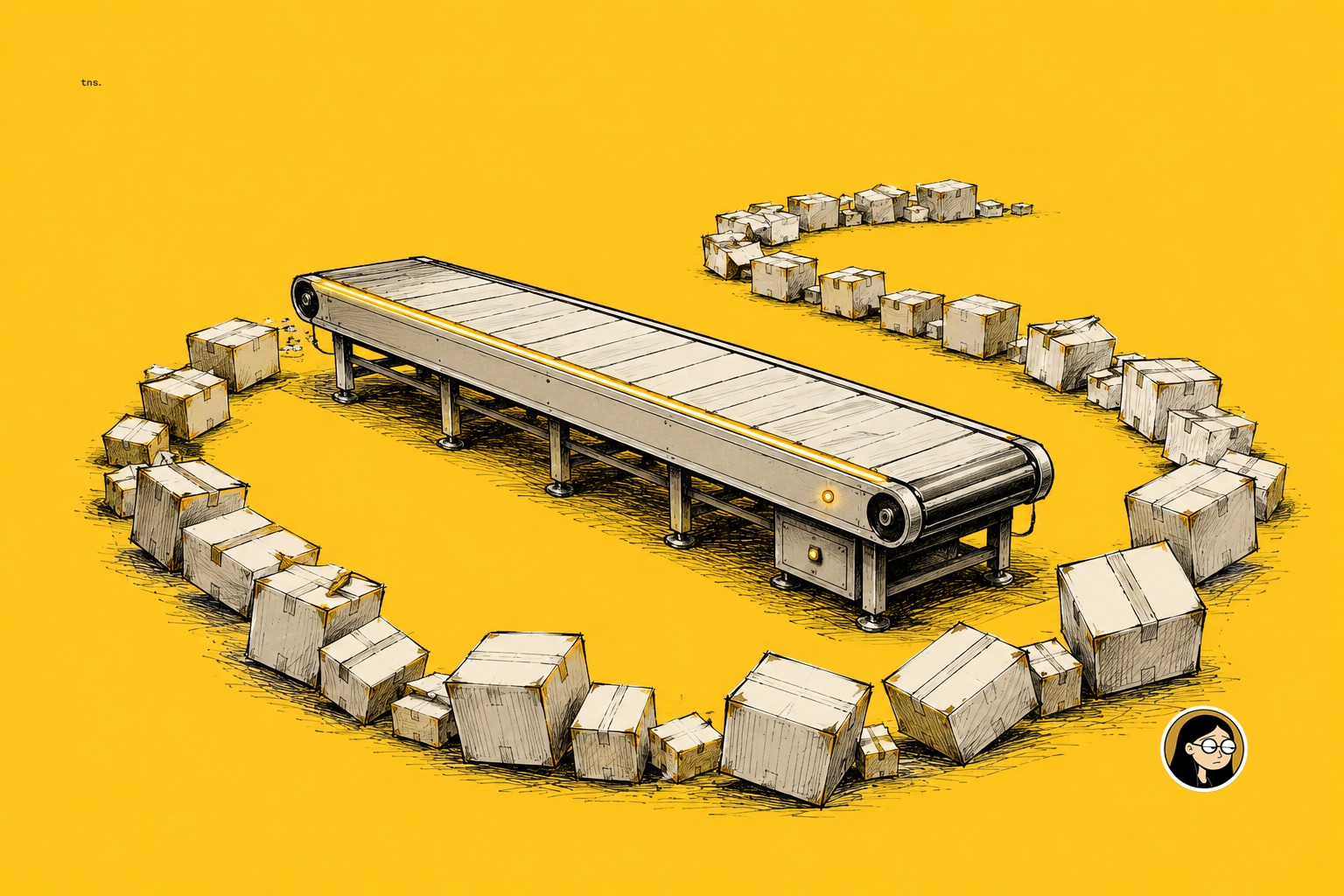
AI Can't Fix a Coworker Who Won't Use It
A sales rep dropped a screenshot into our team chat at 9:47 in the morning. The usual setup. A client message, no formatting, no context, capped with the words “can you help me sort this out?”
Three of my colleagues started typing back. One was pulling pricing from a spreadsheet. Another was rewriting the client’s vague request into something that resembled a brief. A third was checking last month’s notes to see what context might be missing.
I opened the tool I built for exactly this situation. Same screenshot, pasted. Three seconds later, the full output sat in front of me. Client request, structured. Quote table, populated. Internal notes, separated cleanly from the deliverable summary. The whole layout that my colleagues were now hand-typing into chat, line by line.
I watched them type. I sat with my finished output. The tool kept refreshing, patient, available, totally idle for everyone in the team except me.
The tool I built has one user. It is me.
This is not the story of a bad tool. The tool works. I tested it on real cases until it could absorb whatever raw mess sales dumped at it. The output is good enough that the only complaint a client ever had was that the layout was “too neat.” The tool is not the problem.
The tool is the punchline.
The wrong question
Most of the AI conversation in this industry orbits the question of capability. Can it find the creators? Can it write the brief? Can it haggle? The benchmarks are public. The demos are loud. The replacement panic is constant.
The internal reality is much quieter. Most AI tools deployed inside teams don’t fail because they cannot do the job. They fail because nobody opens them.
And the easier the tool, the more easily it gets skipped. Friction has a strange property nobody likes to talk about: when there is no penalty for ignoring a tool, “easy” stops being a benefit. It becomes optional. And optional, in any team carrying any real workload, is a synonym for last.
The real bottleneck is not capability. It is the question of who, in your team’s quiet little org chart, will absorb the unfinished work for free. I wrote a few weeks ago about how nobody downstream gets paid for the rework. The same pattern, dressed in different clothes, eats AI tools alive: when the cost of an upstream choice never reaches the person who made it, the upstream behavior does not adjust. Nobody is going to walk an extra two steps to use a tool when the alternative is dropping a screenshot in a chat where someone else will translate it.
A tool only replaces what a human refuses to keep doing. If somebody downstream keeps doing it anyway, the tool replaces nobody.
This is not a software problem. It is an org chart problem wearing software’s clothes.
The three flavors of quiet refusal
After deploying enough internal tools, you start recognizing the patterns.
The first is the “too busy, I’ll try it later” person. They mean it, sort of. They will not try it later. “Later” is the polite word for “no.” Willingness, in this case, disguises itself as scheduling. They are forever about to use the tool, the way some people are forever about to start learning Spanish.
The second is the “tried it once, hit a glitch, never came back” person. They gave it exactly one shot. That shot happened to be the bad one. They saw an awkward output, a moment of friction, a thing they didn’t immediately understand, and they walked. Their conclusion was permanent. Their evidence was one data point. You will not recover that user with a changelog.
The third is the deadliest, because it makes no sound. It is the person who just keeps doing things the old way. No objection. No complaint. No ticket filed. They did not reject the tool. They simply never reached for it. Meanwhile you assumed they would come around. They assumed you would keep cleaning up. Both sides waiting for the other to move first, indefinitely, while the tool sits unused and the workflow stays exactly the same.
There is no conflict to resolve, which is why it is the worst kind. You can argue with a complainer. You cannot argue with someone who is politely, peacefully, contentedly carrying on as if your tool does not exist. Their non-use is not a position. It is just gravity. The hardest behavior to change is the one that has no visible decision behind it.
I wrote a while back that AI can probably eat the 80% of agency work that is repeatable. I stand by that. The asterisk I should have added: it can only eat that 80% if somebody, anybody, is willing to feed it. The tool’s appetite is fine. The hand that fills the tray is the problem.
What actually moves the needle
The instinct, when you see this play out, is to “train the team better.” Run another onboarding. Write another doc. Record another video. Pin the link in chat one more time. None of this works, because none of it touches the actual mechanism. The mechanism is not ignorance. The mechanism is that somebody downstream is fine catching the ball. Training a competent adult to do a one-click thing they were already capable of doing does not change willingness. It just adds another deck to the pile of decks they will politely never open.
The real interventions are structural, and there are roughly three.
Stop catching the ball. When sales drops a raw screenshot in chat asking for manual cleanup, you do not clean it up. You point at the tool. It feels like punishment. It is actually the first time the team has had to see the real cost of skipping. No reflected cost, no behavior change. Ever.
Make the tool the only entrance. Client information that does not come through the tool does not get processed. The friction moves from “using the tool” to “not using the tool.” The path of least resistance now leads where you want it to. This is the only intervention that does not require you to police anyone, which is also why it is the only one that survives the week.
Tie it to a number that already matters. Whatever metric your team is being measured on, attach tool usage to it. You do not need to win a debate about adoption when the KPI quietly disqualifies the skippers.
Now the honest part.
Every one of those three interventions requires someone with authority to back you up. From the bottom of the org, you cannot do any of them. If you do not have that backing, the only intervention left is the one nobody wants: admit that you are the free buffer keeping the whole workflow polite, and decide how long you are willing to keep being one.
That last part is not a strategy. It is a confession dressed as one.
The bottleneck was never the tool
There is a particular flavor of despair reserved for people who build something genuinely useful and then watch it sit idle while the same work gets done the slow way, right next to them, every single day. It is not anger. It is not even disappointment. It is the quiet recognition that the bottleneck was never the one you thought it was.
You can build the best tool of your career. If the person downstream keeps catching the ball, nobody upstream will ever notice the tool exists.
The tool works. The humans don’t.