"It's Not That Complicated" Is the Most Expensive Sentence in Marketing
A friend texted me last week. She runs marketing at her company. Her new manager had just informed her that taking a new product to market was, and I quote, “not as complicated as you think.”
She sent about nine messages in a row. I won’t reproduce them. The polite summary is that she disagreed, with feeling.
I sympathized. I also didn’t have much to add, because I’d heard the exact sentence before. From my own boss. From a colleague two desks over who has never run a campaign in his life. Different companies, different industries, same five words. It’s not that complicated.
Here’s the thing about that sentence. It is never a description of the work. It’s a move.
Think about who says it.
It isn’t the person doing the work. The person doing the work knows precisely how complicated it is, because they’re currently holding all of it in their head. It’s the person one level up, or one department over, or on the client side of the email thread. Someone who has to sign off on it, schedule around it, or pay for it.
For them, “complicated” isn’t a fact about the work. It’s a cost. Complicated means slower and more expensive. It means deferring to someone else’s judgment, which is uncomfortable, because they’d rather be the one giving instructions.
So they shrink it. “Go to market” becomes “just launch the thing.” “Build the influencer program” becomes “find a few creators and have them post.” “Write the brief” becomes “send them what we want.” And once the work is small, a lot of convenient things follow. You can compress the timeline, because how long can a small thing take. You can question the price, because why would a small thing cost that. You can overrule the specialist, because it’s not exactly rocket science.
It’s rarely malice. Mostly it’s just the cheapest posture available. Pretending something is simple is free. Understanding why it isn’t costs you the time to understand it, and most people up the chain would rather not spend it.
And the influencer industry runs on this posture, top to bottom. The client says it to the agency. The agency, quietly, sometimes says it to the creator. The creator hears it from their own manager. Everyone is shrinking everyone else’s job to make their own day lighter. Ever notice the energy is never on the deliverable?
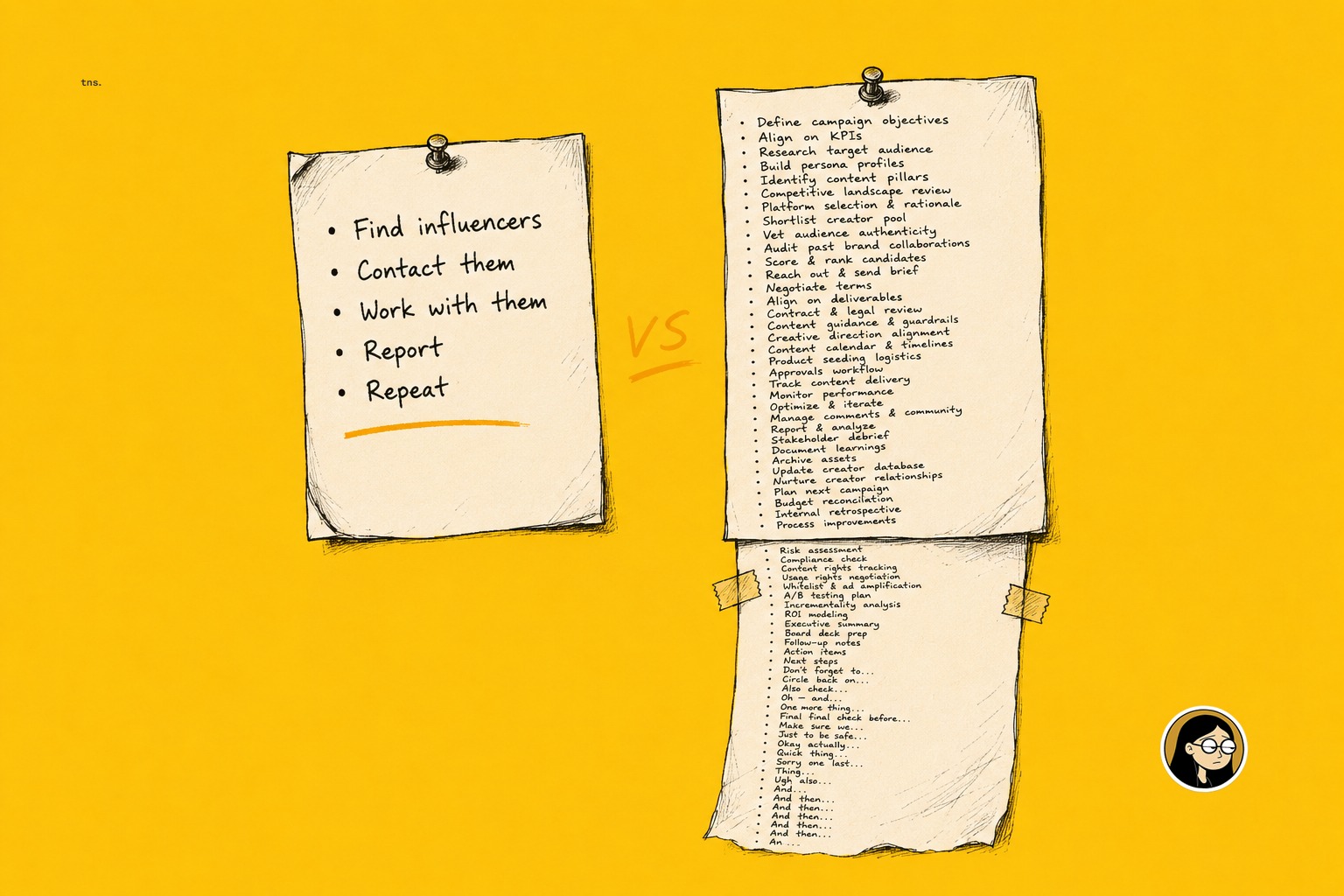
Here’s what influencer marketing looks like if you’ve never done it. You find some influencers. You contact them. You work with them. You report on it. You repeat. Five steps. Reasonable. Fits on one slide with room to spare.
And here’s a partial list of what “work with them” contains. Research the audience you’re actually trying to reach. Work out what that audience cares about. Set creator criteria for the campaign. Discover and build creator lists. Segment those lists. Write the brief. Build outreach templates and personalize every one. Send the outreach, in sequence or by hand. Follow up weekly, per list. Manage the inbox so nothing falls through. Have the rates-and-insights conversation. Get on creator calls when it comes to that. Negotiate. Contract. Ship product. Brief them, on a call if needed. Onboard them to the product. Manage the relationship through every question about the brief, the features, the timing. Run the campaign: UTMs, CRM, tracking codes. Review content and give feedback. Send timeline reminders, which is the polite term for chasing people. Wrap up the campaign. Handle invoicing. Follow up on payment. Capture all the content. Update the CRM with insight links and status. Refresh the stats every couple of weeks. Pull the analytics together. Support distribution. Plan the next round, including who to rebook.
That’s the short version. I left things out.
So when a client looks at the five-step list and says “this should be cheap,” they’re not wrong about the five-step list. They’re wrong about which list they’re holding. The five-step version is the marketing equivalent of “draw the rest of the owl.”
It’s also why “why is this quote so high” is such a tell. The quote feels high against the imaginary five-step job. Against the real one, it usually isn’t. A creator’s number isn’t a mood. It’s reach, engagement rate, the hours the content actually takes, exclusivity, usage rights, and the small fact that “one more call” is also labor. Think about what’s inside “just one post”: a concept that fits the creator’s voice instead of fighting it, a script, a shoot, an edit, the disclosure line, the revision round, posting at the exact hour some campaign mechanic demands, and the audience they spent years earning. None of that shows up in the deliverable. Almost none of it shows up in the post. And things that don’t show up are very easy to call free.
This is roughly the point in a campaign where it helps to have something to point at. A rate benchmark, or a tool that shows what comparable creators charge. It won’t settle anything by itself. It just moves the conversation from “that feels expensive” to “here’s the market,” which is a much shorter argument to have.
Clients mostly half-know all this. That isn’t the maddening part. The maddening part is the timing. The moment they call the work simple, they’ve already repriced it. The sentence and the discount arrive together.
So what do you do. A few things, and none of them is “educate the client,” because you’ve tried that and it doesn’t take.
Read “it’s not that complicated” as a number, not a fact. It’s an opening offer. Your counterpart is signaling what they’d like to pay, in money and in time. You’re allowed to answer with an offer of your own. You don’t have to win the argument about complexity. You have to not accept the implied price by default.
Put the invisible work in the scope. This is the boring point and it’s the one that matters. If the hundred small things only live in your head, they’re free. Write them down. “Includes up to two rounds of revision.” “Includes briefing call.” “Reporting at campaign close, refreshed once at thirty days.” It reads like nothing. It’s the line between work you’re paid for and work you quietly absorb. A brief should specify platform, objective, timeline, and what’s actually included. Revolutionary stuff, I know. In practice, almost nobody writes that last part down.
Bring a comparison, not a complaint. “This is complicated” is something you feel. “Here’s what comparable creators charge, here’s what this scope covers, here’s what comes out if the budget is X” is something the other side can act on. Same with internal stakeholders. You won’t out-argue someone’s gut feeling. But you can put a market rate and a line-item scope on the table next to it, and let those do the talking.
Know which fights to skip. Some people will say “it’s not that complicated” until they retire. You’re not going to convince them. You can make the scope tight enough that their opinion stops costing you anything.
My friend’s plan, after the nine messages, was to run the not-complicated launch and let the timeline answer for her.
It’ll answer. It always does. But there’s a faster version of the lesson, and it’s the one worth keeping: the work that isn’t in the brief is the work you do for free, and “it’s not that complicated” is just the polite way of asking you to keep doing it. So write the brief. The boring part, the one that lists what’s included. That’s the whole defense.