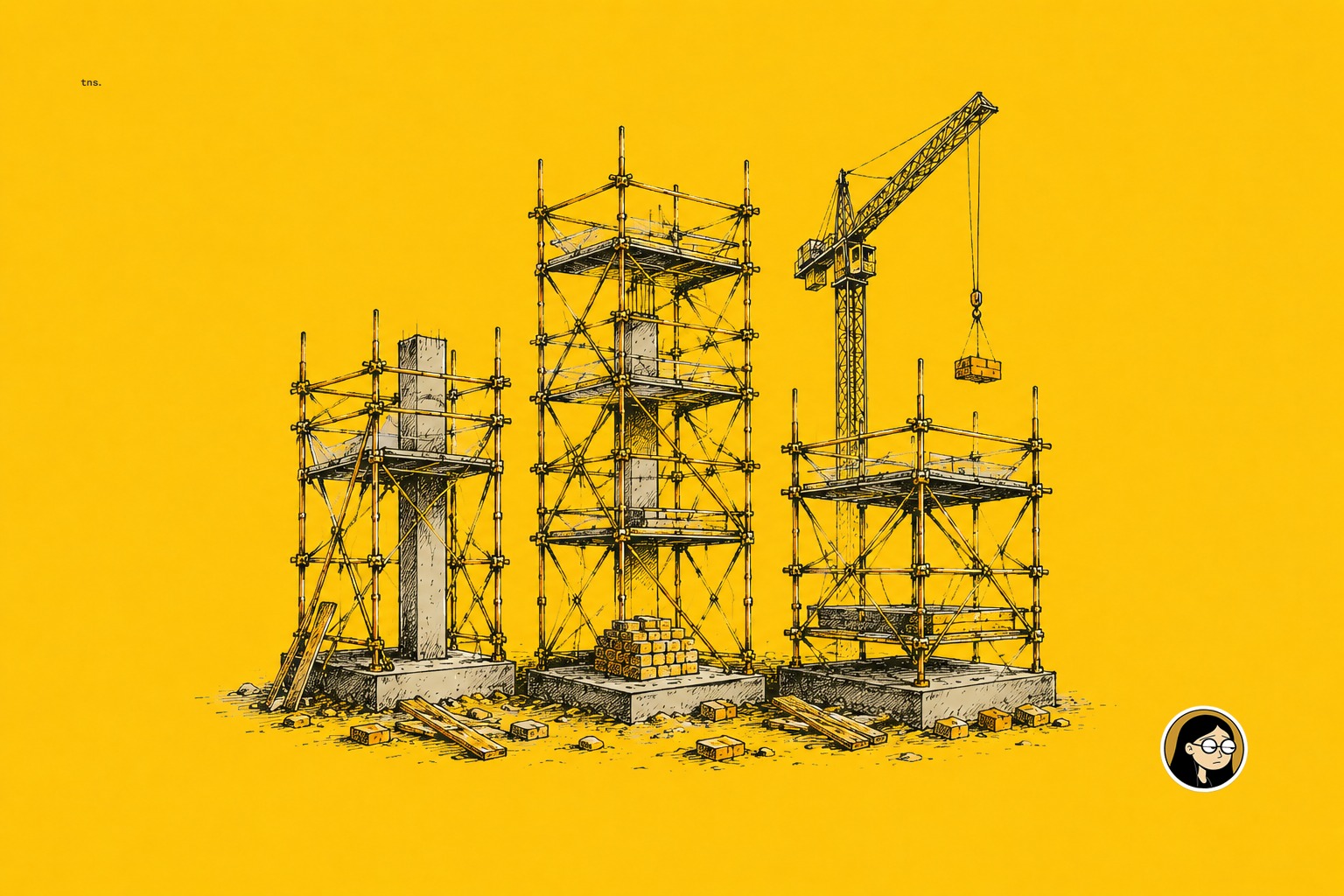
Building Everything Is Building Nothing
Three years ago, my company started building an “all-in-one influencer marketing platform.”
The pitch was beautiful. Project management. Finance. Logistics tracking. Contract signing. A creator search function so good it would put the incumbents out of business. All under one login. All seamless. All sometime soon.
Three years later, the basic creator search still doesn’t work. Not “it’s missing features” doesn’t work. “It returns the wrong results to the simplest query” doesn’t work. The kind of doesn’t-work where if you handed it to a paying customer, they would never use it again.
Last week, after thirty-six months of development, the team shipped what it billed as the company’s first AI feature.
It is OCR. It auto-fills forms from screenshots.
Welcome to 2026.
I want to be careful here. I don’t think the engineers are bad. I don’t think the product manager is lazy. I’ve watched these people work, and they are not the problem. The problem is upstream of all of them, in a sentence that gets repeated at every year-end meeting like a prayer:
We’re being ambitious because the market demands a comprehensive solution.
That sentence is the entire article.
Comprehensive is the most expensive word in B2B.
It sounds responsible. It sounds like rigor. It sounds like someone who has thought through every angle and is bravely committing to all of them. But in practice, comprehensive is what you say when you haven’t decided what you’re not going to do.
Picking is the hardest part of strategy, and not because it’s intellectually difficult. It’s hard because picking generates enemies. The feature you don’t build is a feature a stakeholder asked for. The market segment you don’t serve is someone you turned away. The use case you didn’t optimize for is a deal your competitor will close. Every “no” has a face attached, and most executives would rather avoid the conversation than have it.
So instead of picking, they say comprehensive. They say all-in-one. They say flexible. They say platform.
The work has not been done. It has been moved out of the room, dressed up as ambition, and put on the roadmap as five competing modules with the same Q4 launch date.
There is a math problem nobody on the leadership side wants to acknowledge. Every feature on a “comprehensive platform” roadmap is in queue with every other feature for the same engineering hours, the same product cycles, the same QA bandwidth. You are not building five things in parallel. You are rotating through five queues, none of which ever empties. The thing that ships first is whichever one is easiest, not whichever one is most important.
Which is how, in 2026, you ship OCR.
Once you can see this pattern, you see it everywhere.
I see it in client briefs. The brief lands in the inbox in language that sounds collaborative and modern.
Our target audience is everyone, 18 to 55, men and women, but skewing where the engagement is. The budget is open. We’ll see what performs. We want viral organic growth, and conversion, and brand awareness, and a long-term community, and a sales lift if possible. KPIs? Let’s keep them flexible until we see early data.
This is not a brief. This is a wishlist written by someone who hasn’t made a decision yet, formatted as a creative direction.
The agency, trained to be agreeable, nods. The strategy goes wide. The campaign is built to appeal to everyone aged 18 to 55, optimized for nothing in particular, measured by KPIs that drift over the course of the project. Three months later, the post-mortem deck goes up. The client says the agency didn’t deliver “real impact.” The agency, in private, says the client never told them what mattered. Both are correct. Neither is willing to admit the original problem: nobody picked.
The tell isn’t the audience size. It isn’t the budget number. The tell is the word “open.” Open audience. Open budget. Open brief. Open is the language of someone who hasn’t decided.
I see it in job descriptions, too.
We’re looking for a marketing generalist who can run paid social, write organic content, manage influencer relationships, plan events, build email funnels, do basic SEO, design assets, and report to leadership monthly. Bonus if you have agency experience and speak a second language.
Translation: we don’t know what we need this role to do. We’re going to hire someone cheap, hand them nine bullet points, and have them figure it out. When it doesn’t go well, we’ll quietly assume it was a hiring problem.
I have watched this exact role be filled three times. Three months in, the new hire is doing all nine things badly because no human can do them well in parallel. Six months in, leadership is reviewing whether marketing is “underperforming.” Twelve months in, the role is open again. The new job description has the same nine bullets. Nothing has been learned, because nothing was decided.
How many “marketing generalists” have to fail at the same impossible role before someone in HR notices the role is the problem?
Constraint isn’t a limitation. Constraint is what allows the thing to ship at all.
A SaaS that picks one job (“we are the best creator search tool, and only that”) ships it in twelve months and earns the right to expand. A brief that picks one audience and one outcome (“Singaporean women aged 25 to 35 who distrust traditional skincare brands; conversion as primary KPI”) gets you a campaign with a sharp angle, creators who can credibly speak to it, and a measurement plan that doesn’t drift halfway through. A job description that picks one mandate (“own paid social acquisition end-to-end, report on CAC monthly”) gets you a hire who can be evaluated against something real.
In every case, the picking is the work. Strategy isn’t downstream of the picking. Strategy is the picking.
If you are looking at a brief, a roadmap, or a job description that wants everything, the move isn’t to argue about budget or timeline. Those will be defended. The move is to ask one quiet question:
If we could only do one of these well, which would you pick?
Most of the time, the requestor doesn’t have an answer. That isn’t a problem. That’s a diagnosis. You have just discovered that the brief was never a brief, the roadmap was never a roadmap, the job description was never a job description. They were feelings. Sometimes the right move is to help the requestor turn the feeling into a decision. Sometimes the right move is to decline before you absorb the cost of their indecision.
The same question works internally. If we shipped only one of these in the next twelve months, which would matter most? If the honest answer is “all of them are equally important,” you are not on an ambitious team. You are on a team that hasn’t decided what to build.
Three years into my company’s platform, I still don’t know what the product is for. Whenever I ask, the answer is some version of for everyone who works in influencer marketing, end-to-end. That sentence has been the answer since year one. No clarification has been added. No prioritization has been made.
The roadmap looks longer every quarter. The shipped feature list does not.
Next quarter, leadership says, we are launching the integrated finance module, the one that has been on the roadmap since the company was founded. Whether anyone is actually using the product by then is, apparently, a separate conversation.
Building everything is building nothing.
You’re not broad. You’re undecided.